
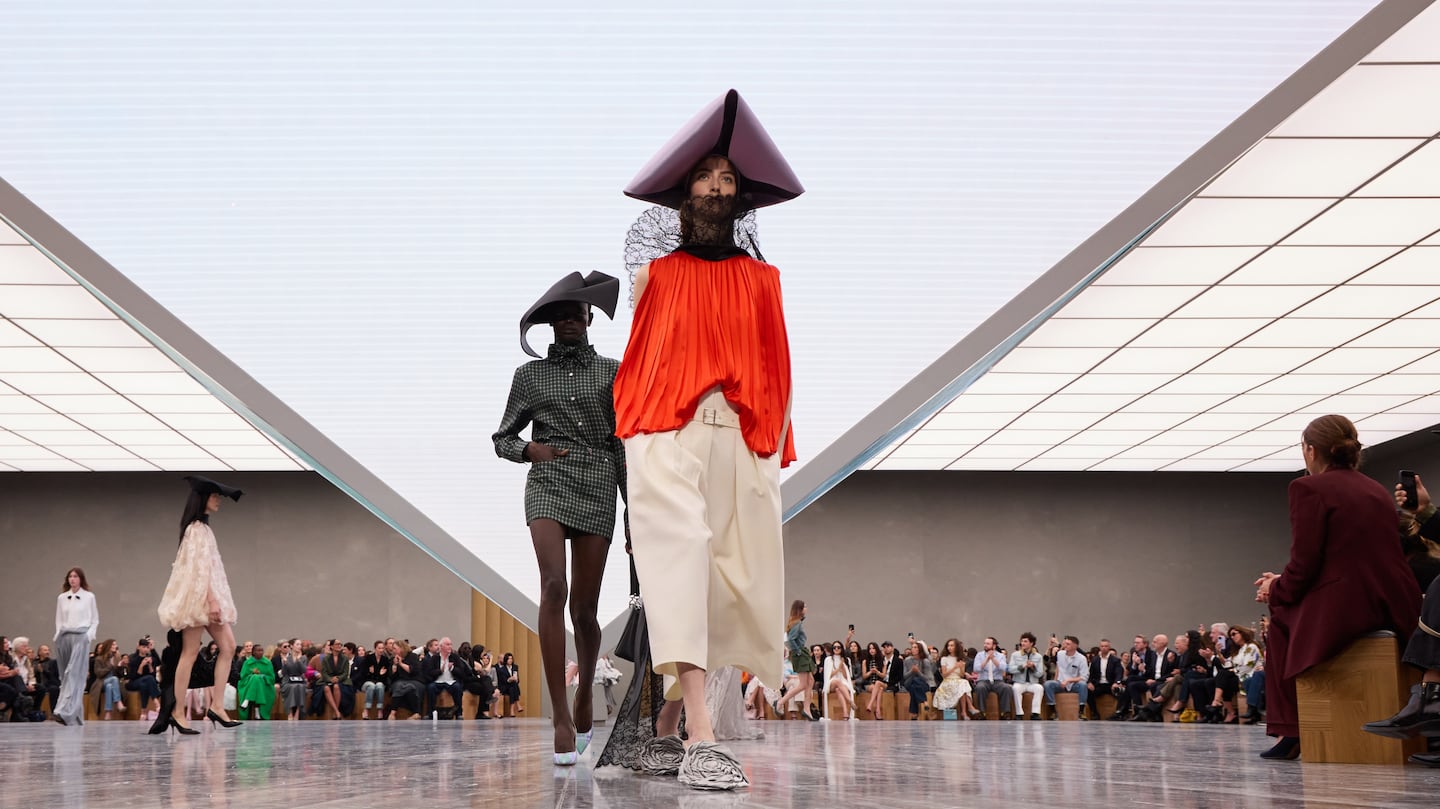
Vogue manufacturers throughout the land have lengthy been formed by the work of Phoebe Philo. Now, a form of Miu Miu-fication is underway. However the trend scene stays largely stale, partly because of the recirculation of the identical artistic administrators. And, let’s face it, every designer has a signature language that may — or can not — be tailored to suit a brand new label, so it’s straightforward to see remnants of what they did earlier than.
Did Matthieu Blazy take pleasure in any of the fabric and formal experimentations that outlined his Bottega Veneta, to not point out the notion of a group spinning in as many alternative instructions because the variety of appears to be like, when he made his grand debut at Chanel? He did, utilizing the love story between Gabrielle Chanel and Boy Capel as a story thread as he deconstructed the home codes (and gloriously mentioned goodbye to the tyranny of the interlocking Cs).
Have been there any of Jonathan Anderson’s playful abstractions from Loewe at Dior, the place he unveiled his imaginative and prescient of womenswear this season? They had been there, freshly and efficiently Dior-ified, woven with clever forays into the archive to pillage model signifiers and make them trendy.
Did Pierpaolo Piccioli deliver his style for purity vibrating by means of color to Balenciaga? He did, in a group that might bear the “Valenciaga” label and that picked up precisely the place he left off a yr and a half in the past, whereas making an attempt to remake Balenciaga with a long-missing sense of magnificence — in flip flops quite than pumps, nevertheless.
Did Duran Lantink luxuriate in his penchant for bulbous hypersexuality and provocative mock-nudity at Jean Paul Gaultier, a lot in order that, save for the odd sailor stripe and tattoo print, it regarded like a legit continuation of his personal label below a brand new identify, in his debut for the home? He did, and all the higher for that. It made for one daring, unrelenting, extremely debated second in an in any other case fearful season. (The Adam Curtis movie Anderson screened earlier than his Dior present was very well timed on the subject of concern.)
Concern is maybe the sensation one felt most after this spherical of exhibits: concern, and a normal unwillingness to take dangers. These days, collections not often, if ever, go for the conciseness of a single, unremitting trend assertion, one which requires a intestine response: Quite, they lukewarmly or devilishly delve into as many potentialities as a designer can dish. Is that the results of merchandising taking management of collections and the crucial to hit as many buyer constituencies as potential? Probably.
There have been at the least three or 4 totally different collections occurring at Balenciaga. One — black, taut, arduous — regarded promising and price exploring extra. The others had been slightly deja-vu. The fragmentation of Anderson’s message was evident at Dior, the place he explored quite a lot of aspects, going from hypernormality to panier shapes, with volumes, elongation and sculptural tailoring in between. There was actually loads occurring, not all of it completely resolved, however what felt new was the tone: new, and far wanted, on the home of Dior, which may be so pompous and self-absorbed. That, and a eager research on equipment and diversification, with a business savviness that felt jolly, not soulless. On high of this, the thought of name identification as prismatic is integral to Anderson’s apply — and reflective of his a number of pursuits.
Matthieu Blazy fell close by, and his Chanel debut made it clear. His signature as a designer doesn’t lie in the best way he tells a narrative by means of clothes, however in the best way he lets materiality outline form, generally compelled, generally translated into ineffable concord, pushing the experimental urge so far as potential. His collections, in consequence, seem like clusters of particles not essentially, or not evidently, linked one to the opposite, making a form of dizziness in onlookers as the attention rejoices. This primary outing for Chanel wiped the slate clear, bringing a much-needed freshness to the model but additionally various neo-baroque complication. As a lot because it was new, it additionally regarded acquainted, within the Karl form of method, and never simply due to the Grand Palais: The out-of-control variety of outfits fell there, in addition to the not-always-flattering experiments across the distinction cap-toe on the sneakers. For positive, it was a hit: what the style crowd craved. Then once more, famine could make the eyes hungry.
Miguel Castro Freitas’ Mugler debut was attention-grabbing in its quite strict, architectural tackle archival tropes, however it got here burdened with method an excessive amount of Nineteen Nineties referencing, from Margiela to Gaultier, which, given the unquestionable expertise of this designer, ought to go.
Talking of Margiela, designer Glenn Martens took a unique street along with his ready-to-wear debut from the délabré grand guignol of his Artisanal assortment, realigning the label with its authentic spirit — the identical that, thus far, has been saved alive by sister line MM6, with which conflicts could now come up. Engaged on a vertical silhouette with ingenious tailoring and only a contact of provocation (the stitched mouthpieces), Martens revealed a eager sensibility and a closeness in spirit to Martin which may make the label related once more for actual life past the great catwalk cinematics.
Mark Thomas’ debut at Carven was considerably humble, however mild in spirit, just about within the Phoebe vein with outstanding effortlessness. Better of all had been Lazaro Hernandez and Jack McCollough, whose tackle Loewe was considerably of a shock. As an alternative of mimicking their predecessor’s distinctive antics — on this sense, the artwork on the entrance of the venue didn’t really feel crucial — they opted for a model of American, sports-inflected straightforwardness charged with a super-bright Mediterranean color palette and a few unimaginable craft in leathermaking. Was it extra pre-collection than runway due to straight-out-the present wearability? For positive, and all the higher for that.
And if debuts had been entrance and centre this season, so had been sophomore outings, which is the place a brand new imaginative and prescient actually begins to take form, coming throughout as convincing or crumbling. To make certain, there have been highs and lows. Julian Klausner has a private and commendable view of how Dries Van Noten would possibly transfer ahead. His take is one way or the other blunt, with sharper edges. And but, in comparison with the easy move of males’s, this outing felt a bit unresolved, if nonetheless poetic and energetic, specifically in his use of prints, which lacked a sure finesse.
After hinting in too many instructions together with her debut, Sarah Burton discovered her stride at Givenchy, delving into tailoring with a womanly sense of seduction, a willingness to indicate pores and skin and the openness to totally different ages and physique sorts making for a commanding assertion. Over at Lanvin, Peter Coppings entered a fantasy of the Nineteen Twenties that was as masterful because it was elegant, but additionally barely indifferent from the second, therefore a tad costumey. Issues went higher in menswear, the place in all probability the dearth of archive references ensured a proper freedom that might do nicely at girls’s too.
At Celine, Michael Rider opted for a continuation of his July debut. His tackle the model is tellingly Phoebe — with out the abstractions — with a touch of Hedi — with out the chilly edge. However what makes it particular is its American sense of effortlessness which feels pervasive and private. That, and using the foulard. Together with his second outing at Tom Ford, Haider Ackermann delivered a terrific blow with the sharpest tailoring, essentially the most liquid flou and a sensational palette. It was an ode to seduction that introduced Ford’s antics to sultry however darker heights, and the signal of a real auteur.
Fact be informed, the present was charged with a heavy dose of nostalgia, streaks of which ran throughout Paris, referencing a very grand trend second for town: the Eighties. The danger of all of it trying like costume was excessive, identical to the sheer great thing about it’s excessive. It was evident at Saint Laurent, in an impressive imaginative and prescient of a madame in chandelier earrings cruising by means of a hydrangea backyard quite than the Tuileries, dressed both in black leather-based or flimsy nylon in Matisse colors. Designer Anthony Vaccarello has a singular potential to show one concept into an entire present, discovering energy in lessness: fairly a countercurrent in these everything-at-once instances. Merchandisers will later translate all of this right into a viable business proposition, however as a present it was a blast.
Restraint is proving good for Olivier Rousteing, who retains cleansing up his act at Balmain whereas delving into luxuriant remembrances of the ’80s. This season’s crocheted and draped extravaganza dropped at thoughts Gianni Versace’s Callaghan in the very best method, and felt fascinating. After utilizing a number of seasons to reset the foundations, at Chloé Chemena Kamali went out of her boho consolation zone. By working Fifties florals and couture shapes in humble cottons and draped kinds, she delivered an assured outing.
Issues weren’t nearly as good at Louis Vuitton, the place Nicolas Ghesquière left the sci-fi, boxy rigidities of the previous behind to embrace a negligé or stay-at-home form of fluidity, a behind closed doorways sense of undone coziness. On paper, it sounded good, however on the catwalk it regarded like one other costumey extravaganza, in lighter fabrications. A nostalgic streak is eternally embedded within the work of Alessandro Michele: He seeks magnificence in photos of the previous, that are recontextualised into the current second. Since his arrival at Valentino, Michele has resorted to the form of hyper-styled pastiche that was his signature mode at Gucci, not all the time convincingly. This season one thing modified: The picture was clear, items had been glorified of their great thing about merchandise and the message of magnificence as resistance got here by means of, no strings hooked up. At Ann Demeulemeester, Stefano Gallici’s nostalgia, in the meantime, is of a completely totally different type: Suppose Nineteen Seventies romanticism tainted with streaks of rise up. It’s actually a private interpretation, which doesn’t resonate with the label’s long-time devotees, however it’s attracting a brand new and youthful viewers, and that’s an accomplishment.
Intercourse, in the meantime, retains on promoting, and it was attention-grabbing to see how a lot a imaginative and prescient of sexiness adjustments if it’s a girl or a person expressing it. Of late, Nadège Vanhee has been unafraid to discover a extra carnal edge to Hermès, and convincingly so. This season was the height of this path, with the equestrian heritage bringing on sultry Camargue lands and an interaction of pores and skin and leather-based occurring with the foulard as connector: a crafty approach to play with codes, unexpectedly.
At Alaïa, Pieter Mulier retains celebrating the fantastic thing about the feminine physique in a sculptural method by means of deeply emotional exhibits. The issue along with his imaginative and prescient is that it’s a blast to the eyes, a tour de pressure of invention and ingenious development, however issues do come up when one appears to be like for the interpretation into an actual dressing proposition. It’s totally advantageous, in fact, to work on one thing unattainable and distant, however the home of Alaïa was based on Azzedine’s personal potential to glorify any girl’s physique by means of clothes and reduce, dressing them for actual. Mulier’s arm-concealing capes, fringed stockings and tops that lock the shoulders had been great, however not possible to examine in actual life, and that’s a restrict. The reductionist imaginative and prescient, nevertheless, resounded within the second.
If the season was largely devoid of fearless, confrontational trend moments, Duran Lantink’s Jean Paul Gaultier was an exception, although the shock ways had been maybe overdone. At Sacai, Chitose Abe upped her hybridisation ante, daring to go experimental in silhouette making while retaining the notion of magnificence intact. At McQueen, the resurgence of “bumsters” and parachute clothes regarded compelled: one other try to regain the label’s long-gone cool issue. Butch and femme clashed in charming methods at Zits Studios, whereas Matieres Fecales obtained the children pixilated with their celebration of weirdness in couture shapes which, upon nearer inspection, regarded like a conflict of early Galliano and McQueen on a Rick Owens forged, and never all the time completely resolved.
Talking of Rick, the combination of ethereal and robotic was fascinating, however obtained utterly swallowed by present theatrics that appeared pointless. At Comme des Garçons, it was lumps and bumps once more, however in humble cottons and potato sack linens, and it felt joyous and naive as an alternative of funereal. Over at Issey Miyake, trousers sprouted sleeves and T-shirts rose to the shoulders like they’d company, however it regarded like Viktor & Rolf quite than Issey. Satoshi Kondo is on a mission to develop the model’s vocabulary, which is nice. What ought to keep, nevertheless, is the humanism that could be a founding worth of the home: the notion that even the strangest concept ought to have a that means and a goal, not seem like an ego journey on the a part of the designer.
The thought of repurposing a working class merchandise such because the apron inside excessive trend felt provocative, possibly slightly gratuitous, and that’s what divided the viewers at Miu Miu. In all honesty, it was a improbable, barely risqué look, which triggered reflection not a lot about class battle as a form of extra home, acquainted femininity.
Then, there was Yohji Yamamoto: a timeless grasp who all the time dares to be himself, by no means altering. His chic tackle fluidity in black, white and a touch of crimson felt anachronistic in its celebration of pure dressmaking — in addition to a relaxing balm in a season of change the place, within the grand scheme of issues, not that a lot really modified.